Do we live within a Black Hole? |  |
Do we live within a Black Hole? | |
When the last possible stage of nuclear fusion has ceased in the core of a very massive star, the star explodes as a supernova. If, in the process, a remnant remains whose mass still exceeds two and a half solar masses (m₀ = 5 × 10³⁰ kg), this stellar remnant collapses into a black hole. A stellar black hole with a mass smaller than m₀ cannot form in this way. The physical processes occurring during such a core-collapse supernova have been thoroughly analyzed theoretically, and the results of these calculations are consistent with corresponding observations, for example those of Supernova SN1987A. Since neither dark matter nor dark energy is taken into account in these calculations, the same applies to the following considerations. It is not possible to obtain information from inside a black hole. If one believes (!) the theoretical models, then all the mass of a black hole disappears into a point-like singularity (Schwarzschild metric) or a ring-shaped singularity (Kerr metric). Since neither singularity has any volume, the mass density there is infinite. In view of such an unphysical result, one may doubt whether the theory is applicable to the interior of a black hole and instead apply the simple equations describing the relationship between a mass M, its volume V, and the average mass density ρ. For a black hole, the same relationship between the (Schwarzschild) radius R and the volume V applies as for a sphere in Euclidean geometry.
| (1) (2) | |||||||||||||||||||||
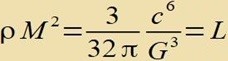
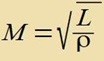
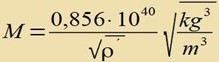
As long as the product ρ⋅M² remains smaller than the constant L, the mass M and its density ρ can assume arbitrary values independently of each other. However, if in a fixed volume the mass increases so much that ρ⋅M² becomes equal to L, then a black hole is created, and due to the relationship ρ⋅M²=L, ρ and M are now inseparably connected. If the mass M of the black hole increases, the volume V becomes larger and the density ρ decreases according to equation (1c). Because no mass can escape from the black hole and, according to equation (1c), ρ is inversely proportional to M², the density ρ cannot become larger. The constant L is an upper limit for the product ρ⋅M². It follows:
| (3) | |||||||||||||||||||||
| (4) (5) (6) | |||||||||||||||||||||
 
| (7) (8) | |||||||||||||||||||||
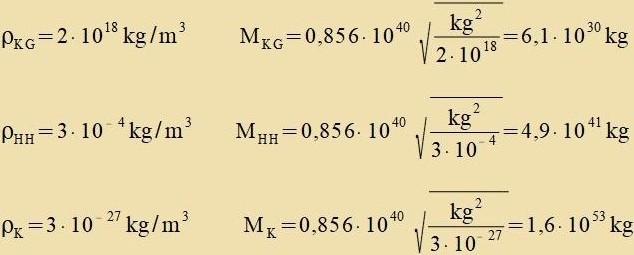
MKG and RKG correspond to the values of the smallest stellar black hole discovered so far. A significantly smaller one is hardly possible. At 5700K, the H-He plasma in the photosphere of the Sun has the density ρHH. When the recombination era of the cosmos begins the density is nearly ρHH. The mass MK differs hardly at all from the estimated (visible) mass of the universe (Wikipedia: ≈ 1053 kg). For the radius of the universe, Wikipedia gives more than 45 billion light-years. That is 4.3⋅1026 m, i.e. about twice RK. While according to the cosmological standard model the entire mass of the universe emerged from nothing in 10-4s, it is assumed here that our cosmos originated in a larger universe as a stellar black hole with approximately the mass MKG (Eq. 4). A black hole with less mass than m0=5·10^30 kg (see above) cannot be formed in a supernova, so a black hole with the mass MKG is at the lower mass limit and the upper limit for the density of a stellar black hole. After its formation, the black-hole cosmos continuously absorbs more or less mass from the surrounding universe. The temporal evolution of the cosmos proceeds from a quark-gluon phase through the same states that are also assumed in the Big Bang theory, but it is not determined by an extrapolated Hubble time; rather, it depends on the irregular absorption of masses from the encompassing universe. According to equations (1), this is associated with an increase in volume and a decrease in density. The cosmos expands, the waves of electromagnetic radiation, which in the early cosmos constitute the main part of the energy and mass, are stretched apart, so that the radiation loses energy. Since radiation and mass are still in thermal equilibrium, the temperature of the cosmos decreases. At 5700 K, the mass of the cosmos has grown to half a trillion solar masses (Eq. 5) and the radius to one tenth of a light-year (Eq. 8b). The cosmos absorbs more mass, the density becomes lower, the expansion continues, and the temperature falls until, at about 3000 K, matter and radiation decouple. The mass of the cosmos now consists of neutral atoms, and the radiation survives as background radiation, undisturbed but constantly becoming longer-wavelength, for billions of years. The measurement of the background radiation provides the earliest experimental result of all, while for the time before it there are only purely theoretical considerations. With z=1100, its redshift is greater than that of any other event in the cosmos. The cosmos as a black hole in the universe has angular momentum. When it absorbs new mass, the event horizon expands, and the centrifugal force pushes mass into the space between the old and the new horizon. The cosmos becomes more inflated at a lower density, and the distances between the galaxies become greater. Because the surface area also grows with each increase in mass, the probability of absorbing new mass becomes greater, causing the expansion to accelerate. With one hundred billion solar masses already at the beginning of the recombination era (Eq. 13), the cosmos, as a black hole, is by far large enough to absorb black holes with several tens of thousands of solar masses from the surrounding universe. In a hydrogen-rich environment, they then grow into the supermassive black holes that appear as very early AGNs of early galaxies. Comparison between the Big Bang theory and the Black Hole Cosmos..
|